


Published: 3rd August, 2026
Leicester University and College Union (UCU) branch has been in dispute with the University of Leicester since 22 May 2025. We entered dispute because the Vice Chancellor, Nishan Canagarajah, and the Executive he leads refused our request “to rule out a programme of collective compulsory redundancies in the 2025-6 academic year”.
Given this formal basis of our dispute, the end of the 2025-6 academic year marks the end of that dispute. We wanted to take this opportunity to reflect on the past year.
A collective effort
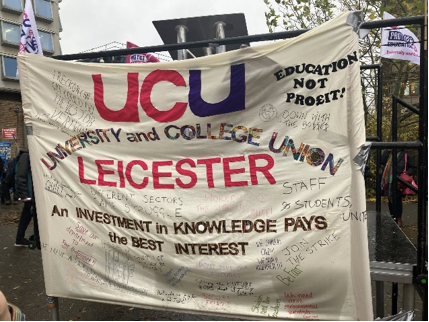
When redundancies were first threatened, Leicester UCU took a decision that we would do everything in our power to oppose job losses. We rapidly organised and won an indicative ballot followed by a statutory industrial action ballot. The result was 31 days of strike action, along with a campaign of Action Short of a Strike and countless protests – including a well-supported national demonstration held in Leicester.
Less visible, but no less important, we have as a branch provided support to every member at risk of redundancy who requested it, as well as having a presence in every single collective consultation meeting.
These initiatives required a colossal collective effort.
We would, therefore, like to express our appreciation of all those within Leicester UCU who:
We would also like to thank our supporters. Union branches up and down the country donated money for our Fighting Fund. Leicester University Unite and Unison branches stood shoulder-to-shoulder with us in meetings. Leicester & District TUC were unstinting in bringing their banner to our events and publicising our dispute. Our local independent MP and our Green Party councillors offered their support and lobbied our Vice Chancellor.
Above all, our students, including those in the affected Schools, were magnificent. Their élan, wit and confidence in holding senior managers to account helped us keep going. They made clear that this was not simply an “industrial dispute” but a battle to defend a whole university community.
Closures and job losses
We did not win every battle. Modern Languages and Film are to be closed. Chemistry and Geography, Geology & the Environment (GGE) experienced an enforced merger. Staff were lost in these areas, together with some in the School of Education and in History, as well as two areas of academic-related professional services: College Operations and Technical and Research Infrastructure Services (TRIS).
Out of 240 directly impacted staff identified at the beginning of the Strategic Review, around 50 will, by the end of the planned “teach-outs” have been pushed out of the university. The closures and redundancies are a reckless act of vandalism by the Executive, damaging our university and the students and staff who could in the future have joined our community. It will weaken our research, our teaching and our reputation.
We continue to offer sympathy and solidarity to all those forced out of the University of Leicester.
Right to fight
Our branch was right to fight against redundancies. The Executive will claim that our struggle was irrelevant to their decision-making; that any mitigation of threatened redundancies was an act of benevolence on their part. There was never the slightest chance that they would say otherwise. To do so would simply be to encourage further defiance.
We are, nonetheless, confident that our struggle did win significant gains for members:
That reflects the pressure of our campaign. Again, this saved jobs.
Even in the past week, we managed to gain a further post into which a staff member at risk was redeployed. The collective campaign at branch level increased our leverage while helping individual members in efforts to save their jobs.
Branch democracy
At every stage in our campaign, we insisted that our branch had to make decisions democratically, through open debate and discussion, and through votes. Members voted to go into dispute and to launch a ballot. Each week before strikes took place, we voted on whether to continue with the planned actions. Along with frequent branch general meetings, we organised strike committees, to help with the logistics of the strikes, and extra meetings of staff in affected areas to offer them greater support.
Not every member agreed with every decision throughout the dispute, but by ensuring the officers leading the dispute were accountable to the wider membership, we ensured that every member had a voice and could shape what we did. It is noteworthy that during the dispute we continued to recruit members and increased our reps and UCU officers.
The Future
We have requested that the Executive rule out launching any further redundancy programmes in the 2026-7 academic year. We await a response. While this dispute is ending, the financial future of the university is unclear. We should be ready as a branch to re-enter dispute if the prospect of further redundancies arises.
Meanwhile we will continue to campaign over matters that affect members, such as intolerable workloads, irresponsible use of AI, and the lack of democracy and accountability in the university’s governance structures. We will continue to involve ourselves in the wider community, whether through offering solidarity to Palestinians or campaigning against the far right. We will offer our backing to other union branches taking action in the coming months.
Through all this, we hope that members will continue to help us build and strengthen the UCU so that we can ensure that our coming struggles are even more effective.
© 2026 - University of Leicester UCU ● Privacy Policy ● v4.0
